Pramāṇa (Śāstra reference)
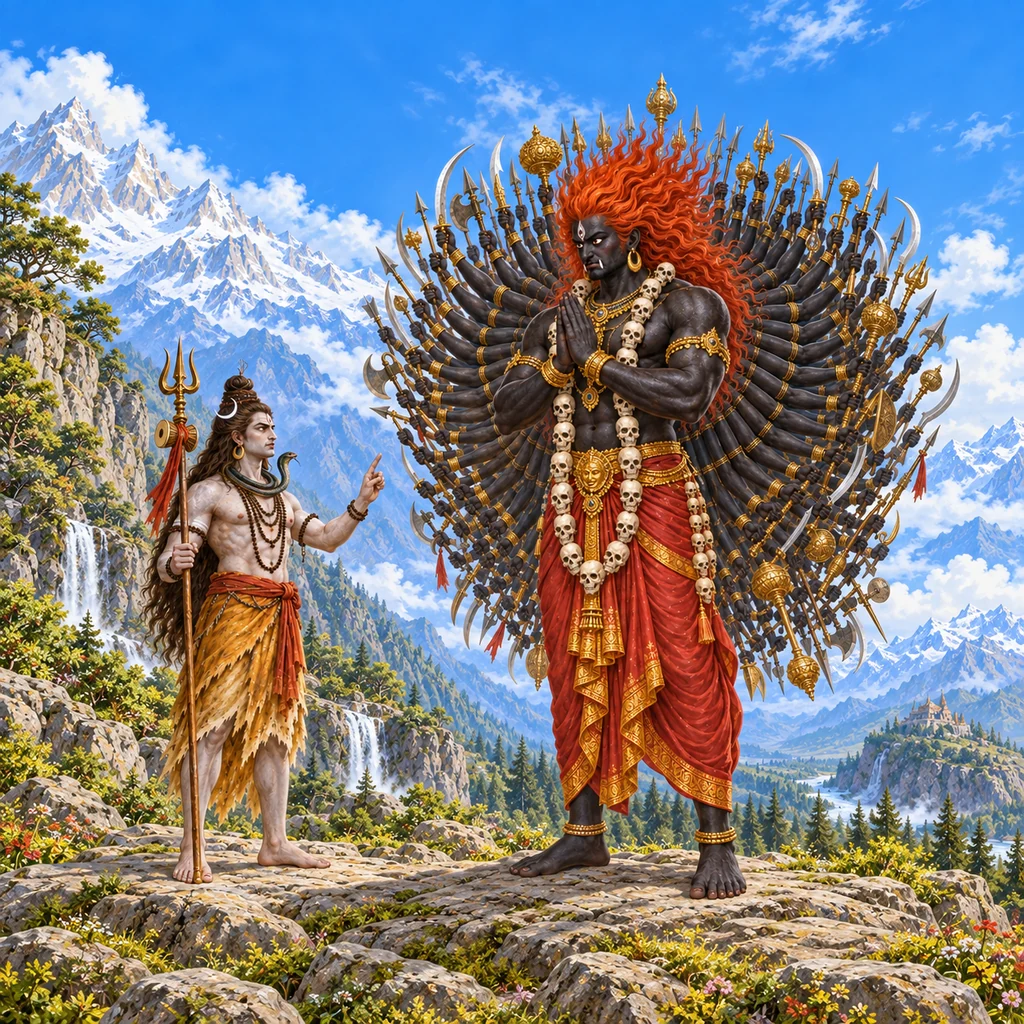
SB 4.5.1–2 describes Śiva’s anger on hearing of Satī’s death and Vīrabhadra’s emergence after a strand of hair is cast to the ground. Verse 4.5.3 specifies his immense stature, black complexion, thousand arms, fearful teeth, fire-like hair, garland of heads and various weapons. The selected moment is 4.5.4: Vīrabhadra joins his palms and asks what he should do; Śiva appoints him to lead his associates against Dakṣa and his sacrifice. The thousand-armed form is conveyed by a layered fan of arms, not by a verifiable rendering of every one of the thousand arms. The skull garland follows the Russian BBT rendering of 4.5.3 and is shown without graphic detail. The third eye is an iconographic detail: the BBT translation renders tri-sūrya-dṛk as brilliance like three suns, not as an explicit count of eyes. The mountains, lighting, garments, ornaments and Śiva’s pose are artistic iconography, not a list of details supplied by this verse. Dakṣa, Satī and the attack itself are not depicted in the selected moment. Additional verses 4.6.35 and 4.7.13 belong to later events and explain Śiva’s position and Dakṣa’s repentance.
Saṅkṣepa (short meaning)
Hearing from Nārada of Satī’s death and the defeat of his associates, Lord Śiva becomes deeply angry. He casts a strand of hair to the ground, and mighty Vīrabhadra appears. Despite his fearsome form, Vīrabhadra first joins his palms and asks for Śiva’s command. He is appointed to lead Śiva’s associates against Dakṣa at the sacrifice. The illustration shows the moment before the march and battle. Later, Dakṣa acknowledges his offense: outward status and ritual cannot replace respect and humility.
Śāstra-pramāṇa (key points from the text)
Nārada’s report
(Śrīmad-Bhāgavatam 4.5.1)
A strand of hair
(Śrīmad-Bhāgavatam 4.5.2)
A fearsome form
(Śrīmad-Bhāgavatam 4.5.3)
An appeal with joined palms
(Śrīmad-Bhāgavatam 4.5.4)
Before the march
(Śrīmad-Bhāgavatam 4.5.5)
Tattva (essential teaching) — with śāstra
Remember the circumstances
A command within a particular account
Śiva is the world’s well-wisher
Dakṣa’s repentance
Sevā today (practice for this day)
How to use this darśanam page
View the image, read the narration and śāstra-pramāṇa, contemplate the tattva, and complete the practice through seva. Follow the sequence: darśana → śravaṇa → manana → seva.