Pramāṇa (Śāstra reference)
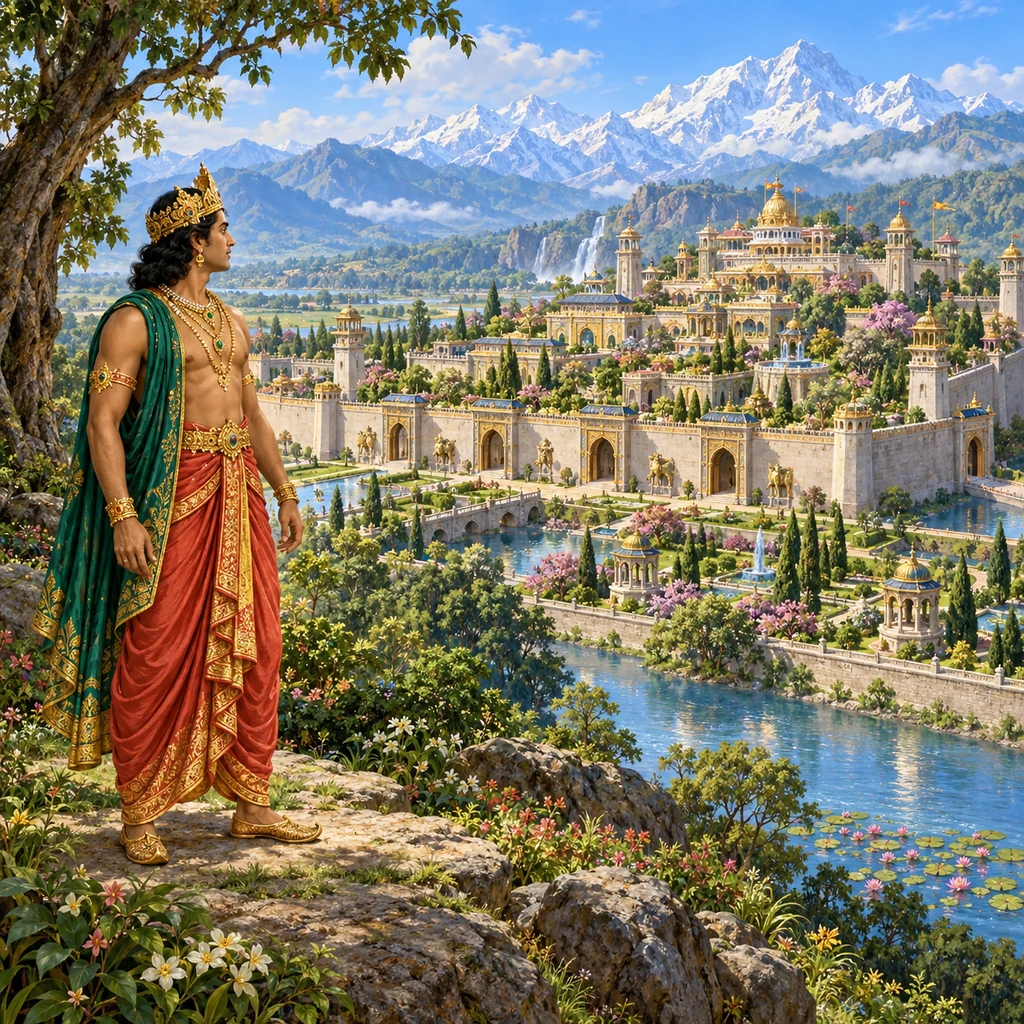
In SB 4.25.13, the wandering Purañjana discovers a city with nine gates south of the Himalayas. Verses 14–15 describe walls, gardens, towers, canals and opulent buildings. The picture selects his discovery of the city, before meeting the maiden. In SB 4.29.2–4, Nārada explains that Purañjana represents the living entity, his unknown friend represents the Lord, and the city represents the body with nine gates. Verse 4.29.9 distinguishes five front gates, one each on the southern and northern sides, and two on the western side. Perspective hides some gates in the picture; it is not an exact architectural plan. The king’s features, crown, clothing colours, sunlight and arrangement of buildings are artistic choices, not details specified in these verses. Purañjana is not depicted as Kṛṣṇa or an avatāra of the Lord.
Saṅkṣepa (short meaning)
In the account Nārada tells King Prācīnabarhi, Purañjana searches for a suitable dwelling. South of the Himalayas he discovers a beautiful city with nine gates. Gardens, fortifications and splendid buildings attract him. Yet the scene invites a deeper question: who lives in the city of the body? Nārada later explains that the living entity passes from body to body, while the Lord remains its eternal friend. Human life offers an opportunity to turn toward Him through hearing and devotional service.
Śāstra-pramāṇa (key points from the text)
A city near the Himalayas
(Śrīmad-Bhāgavatam 4.25.13)
Walls and gardens
(Śrīmad-Bhāgavatam 4.25.14)
Attractive splendour
(Śrīmad-Bhāgavatam 4.25.15)
Who is Purañjana?
(Śrīmad-Bhāgavatam 4.29.2)
The unknown friend
(Śrīmad-Bhāgavatam 4.29.3)
Tattva (essential teaching) — with śāstra
The resident is not the city
Gates connect with the world
Not nine gates in a single row
Hearing turns us toward the Lord
Sevā today (practice for this day)
How to use this darśanam page
View the image, read the narration and śāstra-pramāṇa, contemplate the tattva, and complete the practice through seva. Follow the sequence: darśana → śravaṇa → manana → seva.