Pramāṇa (Śāstra reference)
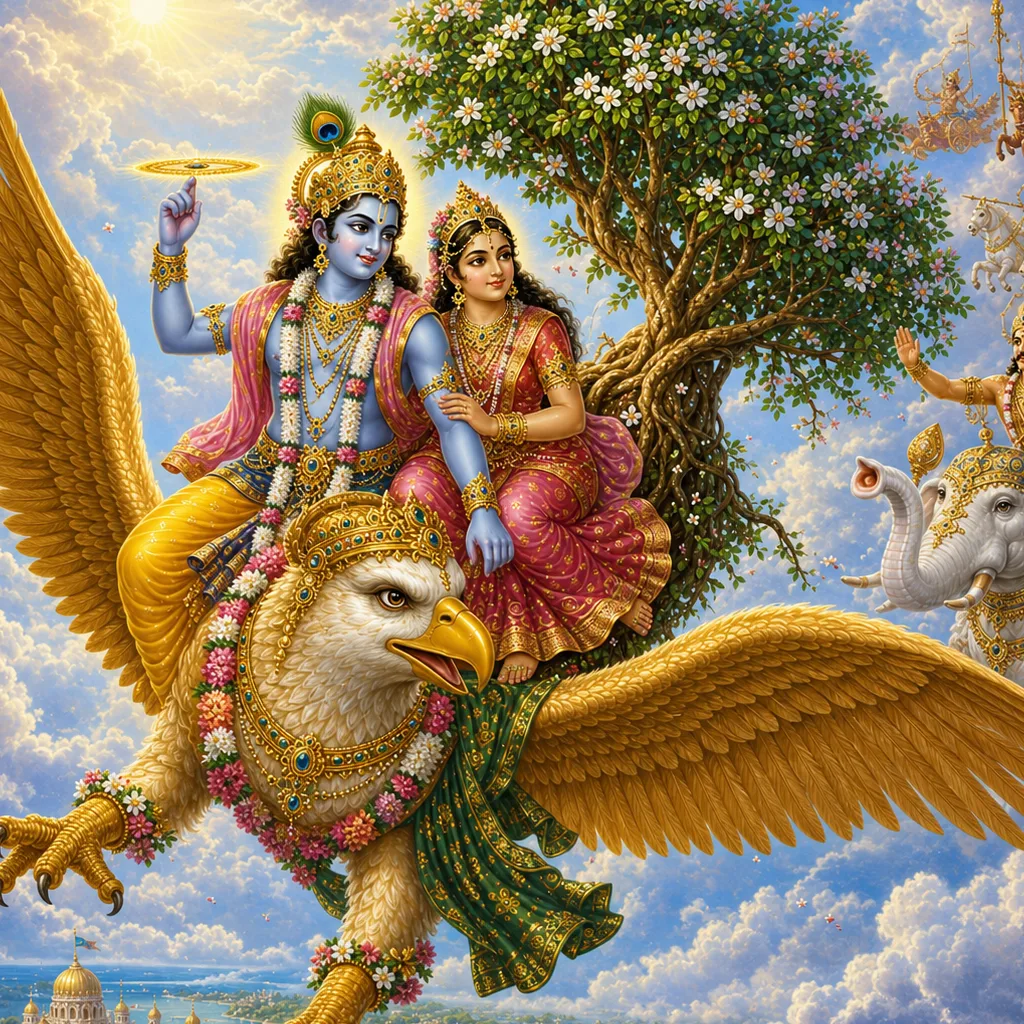
Srimad-Bhagavatam, Canto 10, Chapter 59 describes how, after slaying Narakasura and visiting the heavenly planets with Queen Satyabhama, Lord Krishna uproots the celestial Parijata tree from Indra’s Nandana Garden. Placing the tree upon Garuda, He departs with Satyabhama. Indra, riding Airavata, attempts to stop Him, but after witnessing the Lord’s supreme power, accepts His victory. Krishna then plants the Parijata tree in Satyabhama’s garden in Dvaraka.
Saṅkṣepa (short meaning)
This lila reveals that everything within creation ultimately belongs to the Supreme Lord. Although the Parijata tree grows in the heavenly planets, Krishna, the Lord of all worlds, freely brings it to Dvaraka to fulfill the loving desire of His devotee Satyabhama. Even Indra, king of heaven, momentarily forgets the Lord’s supreme position and opposes Him, but ultimately recognizes Krishna’s sovereignty. The pastime demonstrates that the Lord’s affection for His devotees surpasses all material prestige and celestial opulence.
Śāstra-pramāṇa (key points from the text)
Krishna visits Svarga
(Śrīmad-Bhāgavatam, Canto 10, Chapter 59)
Satyabhama desires Parijata
(Śrīmad-Bhāgavatam, Canto 10, Chapter 59)
The tree is uprooted
(Śrīmad-Bhāgavatam, Canto 10, Chapter 59)
Garuda carries the tree
(Śrīmad-Bhāgavatam, Canto 10, Chapter 59)
Krishna and Satyabhama depart
(Śrīmad-Bhāgavatam, Canto 10, Chapter 59)
Indra confronts the Lord
(Śrīmad-Bhāgavatam, Canto 10, Chapter 59)
Parijata comes to Dvaraka
(Śrīmad-Bhāgavatam, Canto 10, Chapter 59)
Tattva (essential teaching) — with śāstra
Everything belongs to Krishna
The Lord fulfills pure desire
Position cannot surpass devotion
Love is greater than opulence
Sevā today (practice for this day)
How to use this darśanam page
View the image, read the narration and śāstra-pramāṇa, contemplate the tattva, and complete the practice through seva. Follow the sequence: darśana → śravaṇa → manana → seva.