JAPA TIME

Śāstra‑mārga Darśanam — daily lila contemplation

LIVE DARSHAN & DAILY PRACTICE

A śāstra‑mārga darśanam page: image + śāstra pramāṇa + practice.

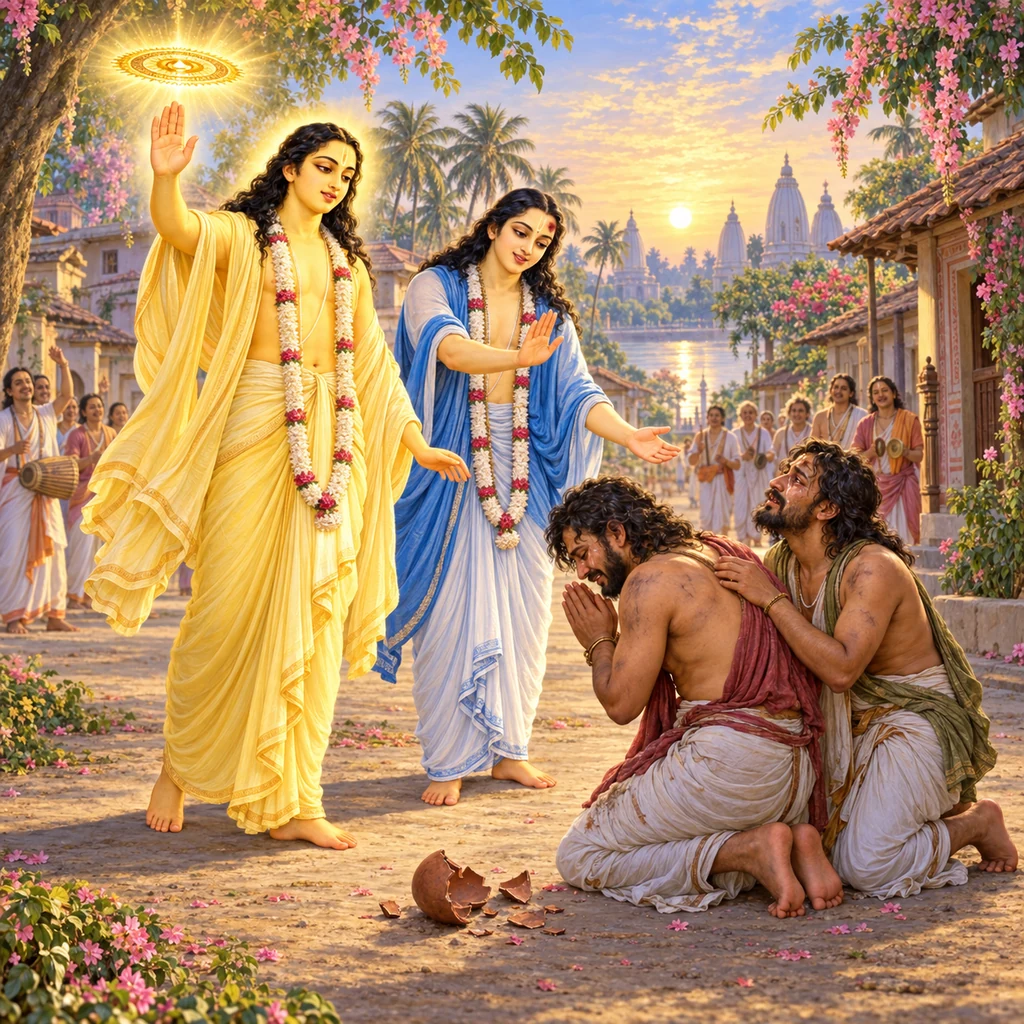
Lord Nityānanda delivers Jagāi and Mādhāi

Lord Nityānanda delivers Jagāi and Mādhāi
Mercy of Gaura-Nitāi Cc. Ādi 17.17
Lord Nityānanda delivers Jagāi and Mādhāi
Śrī Caitanya-caritāmṛta, Ādi-līlā 17.17 and 10.120; Madhya-līlā 16.65

Pramāṇa (Śāstra reference)

The purport to Śrī Caitanya-caritāmṛta Ādi 17.17 describes how Nityānanda Prabhu and Haridāsa Ṭhākura preached from door to door and encountered Jagāi and Mādhāi. The following day Mādhāi struck Nityānanda with a piece of an earthen pot. Mahāprabhu came to punish the brothers, but Nityānanda Prabhu protected them. Seeing Jagāi’s repentance, the Lord embraced him; both brothers accepted the Holy Name and were purified. Cc. Ādi 10.120 calls them the greatest recipients of the Lord’s mercy, and Madhya 16.65 especially glorifies Nityānanda’s mercy in saving them from Mahāprabhu’s wrath.

Saṅkṣepa (short meaning)

When Mādhāi wounds Nityānanda Prabhu with a piece of an earthen pot, Śrī Caitanya Mahāprabhu comes to the scene prepared to punish the offenders. Nityānanda does not ask for revenge; He asks the Lord to bestow mercy upon the brothers. Jagāi repents, and Mahāprabhu embraces him. Mādhāi then surrenders as well. By the mercy of Gaura-Nitāi, both brothers accept the chanting of the mahā-mantra and become devotees.

Śāstra-pramāṇa (key points from the text)

Preaching from door to door
By Mahāprabhu’s order, Nityānanda Prabhu and Haridāsa Ṭhākura carried Kṛṣṇa consciousness from door to door (purport to Ādi 17.17).
(Śrī Caitanya-caritāmṛta, Ādi-līlā 17.17 and 10.120; Madhya-līlā 16.65)

Śrī Caitanya-caritāmṛta, Ādi 17.17

Nityānanda meets the brothers
Jagāi and Mādhāi, intoxicated and hardened, reject the preaching; later Mādhāi wounds Nityānanda with a piece of an earthen pot.
(Śrī Caitanya-caritāmṛta, Ādi-līlā 17.17 and 10.120; Madhya-līlā 16.65)

Śrī Caitanya-caritāmṛta, Ādi 17.17

Mahāprabhu arrives
Hearing of the attack, Lord Caitanya comes to punish the brothers, but Nityānanda Prabhu asks that their lives be spared.
(Śrī Caitanya-caritāmṛta, Ādi-līlā 17.17 and 10.120; Madhya-līlā 16.65)

Śrī Caitanya-caritāmṛta, Madhya 16.65

Repentance meets mercy
Seeing Jagāi’s repentance, Mahāprabhu embraces him; then both brothers receive the Lord’s mercy.
(Śrī Caitanya-caritāmṛta, Ādi-līlā 17.17 and 10.120; Madhya-līlā 16.65)

Śrī Caitanya-caritāmṛta, Ādi 17.17

The Holy Name transforms
Jagāi and Mādhāi accept the chanting of the mahā-mantra and become exalted devotees (Ādi 10.120).
(Śrī Caitanya-caritāmṛta, Ādi-līlā 17.17 and 10.120; Madhya-līlā 16.65)

Śrī Caitanya-caritāmṛta, Ādi 10.120

Tattva (essential teaching) — with śāstra

Mercy is stronger than retaliation
Nityānanda Prabhu responds to His own injury not by demanding punishment but by interceding for the fallen.

Śrī Caitanya-caritāmṛta, Madhya 16.65

The Lord accepts sincere repentance
When a person stops offending and turns toward the Lord, mercy can open a path even after a grievous fall.

Śrī Caitanya-caritāmṛta, Ādi 17.17

The Holy Name purifies
The transformation of Jagāi and Mādhāi reveals the power of sincerely accepting the chanting of the mahā-mantra.

Śrī Caitanya-caritāmṛta, Ādi 10.120

The devotee carries the Lord’s compassion
Madhya 16.65 glorifies Nityānanda Prabhu: it was His mercy that saved the brothers from Mahāprabhu’s wrath.

Śrī Caitanya-caritāmṛta, Madhya 16.65

Sevā today (practice for this day)

1. Chant with hope
During japa, do not consider yourself beyond hope: return to the Holy Name with sincere repentance and attention.
2. Respond with mercy
When one unpleasant action reaches you today, consciously answer without revenge — calmly, truthfully and with concern for the person’s spiritual good.
3. Read the exact sources
Open Cc. Ādi 17.17 and 10.120, then Madhya 16.65 in the JAPA TIME library.
Jagāi and Mādhāi became the greatest recipients of the Lord’s mercy.
— Brief paraphrase of Cc. Ādi 10.120

How to use this darśanam page

View the image, read the narration and śāstra-pramāṇa, contemplate the tattva, and complete the practice through seva. Follow the sequence: darśana → śravaṇa → manana → seva.