Pramāṇa (Śāstra reference)
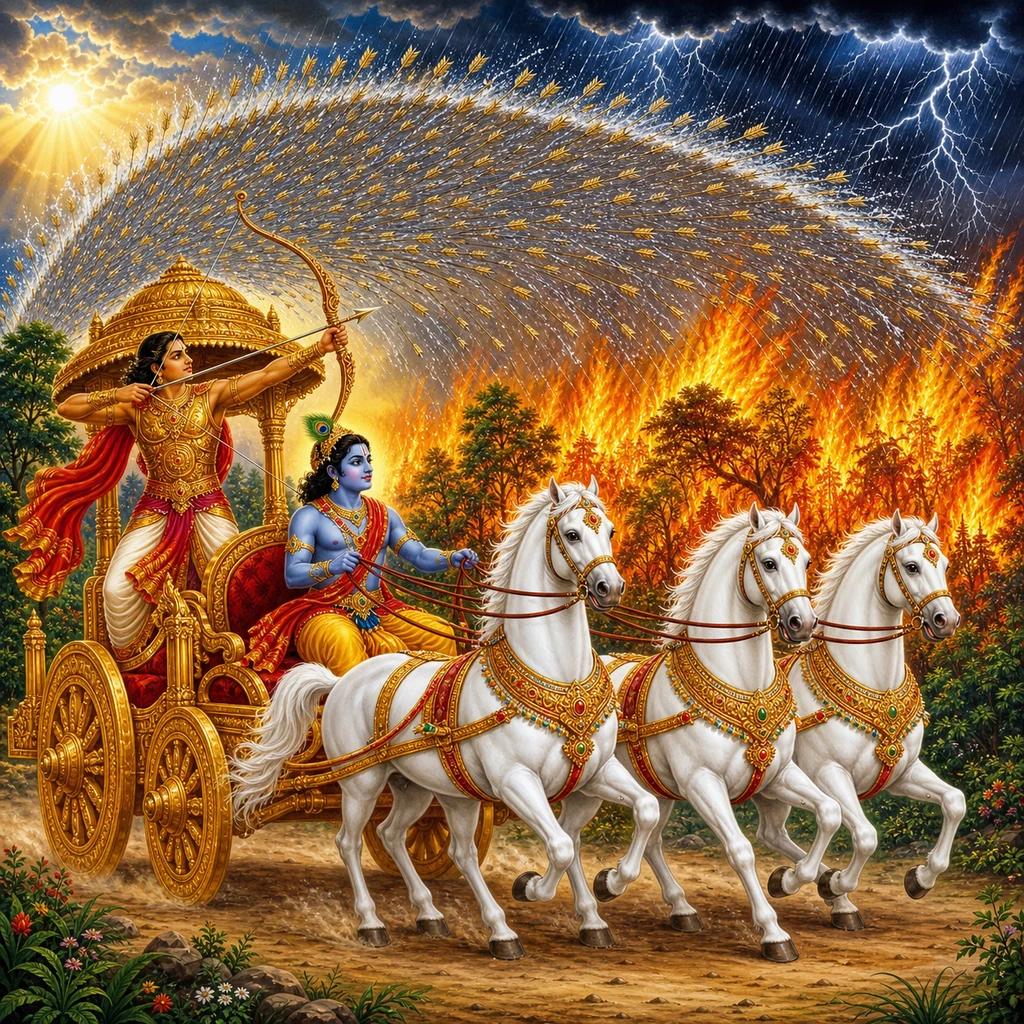
Śrīmad-Bhāgavatam 10.58.25 states that Lord Krishna became Arjuna’s charioteer so that Khāṇḍava could be offered to Agni; verse 26 names the bow, white horses, chariot, inexhaustible quivers and armour. Mahābhārata, Ādi-parva, Khāṇḍava-dāha-parva explains the larger event. Brahmā directs Agni to seek Krishna and Arjuna (section 226). When Agni begins consuming the forest, Indra sends rain, and Arjuna covers the sky with arrows and uses celestial weapons to stop the downpour (section 229). Krishna fights beside Arjuna, and at the close Agni declares himself satisfied (section 236). The illustration combines these stated elements: Krishna as charioteer, Arjuna with Gāṇḍīva, the arrow canopy, rain and Agni’s flames. No suffering creatures are depicted. The account is presented as a particular divine and epic event, not as permission to imitate destruction.
Saṅkṣepa (short meaning)
Agni asks Krishna and Arjuna for help in consuming Khāṇḍava Forest. Krishna takes the reins of Arjuna’s chariot, while Arjuna raises Gāṇḍīva and checks the rain sent by Indra. Their united action enables Agni to complete the task described in the epic.
Śāstra-pramāṇa (key points from the text)
Agni seeks divine assistance
(Mahābhārata, Ādi-parva, Khāṇḍava-dāha-parva 226–236; Śrīmad-Bhāgavatam 10.58.25–26)
The proper weapons are obtained
(Mahābhārata, Ādi-parva, Khāṇḍava-dāha-parva 226–236; Śrīmad-Bhāgavatam 10.58.25–26)
Krishna becomes the charioteer
(Mahābhārata, Ādi-parva, Khāṇḍava-dāha-parva 226–236; Śrīmad-Bhāgavatam 10.58.25–26)
Arjuna checks Indra’s rain
(Mahābhārata, Ādi-parva, Khāṇḍava-dāha-parva 226–236; Śrīmad-Bhāgavatam 10.58.25–26)
Agni completes his task
(Mahābhārata, Ādi-parva, Khāṇḍava-dāha-parva 226–236; Śrīmad-Bhāgavatam 10.58.25–26)
Tattva (essential teaching) — with śāstra
The Lord guides His devotee’s strength
Service requires the right means
Divine narratives must be heard in context
Krishna and Arjuna remain bound in friendship
Sevā today (practice for this day)
How to use this darśanam page
View the image, read the narration and śāstra-pramāṇa, contemplate the tattva, and complete the practice through seva. Follow the sequence: darśana → śravaṇa → manana → seva.