JAPA TIME

Śāstra‑mārga Darśanam — daily lila contemplation

LIVE DARSHAN & DAILY PRACTICE

A śāstra‑mārga darśanam page: image + śāstra pramāṇa + practice.

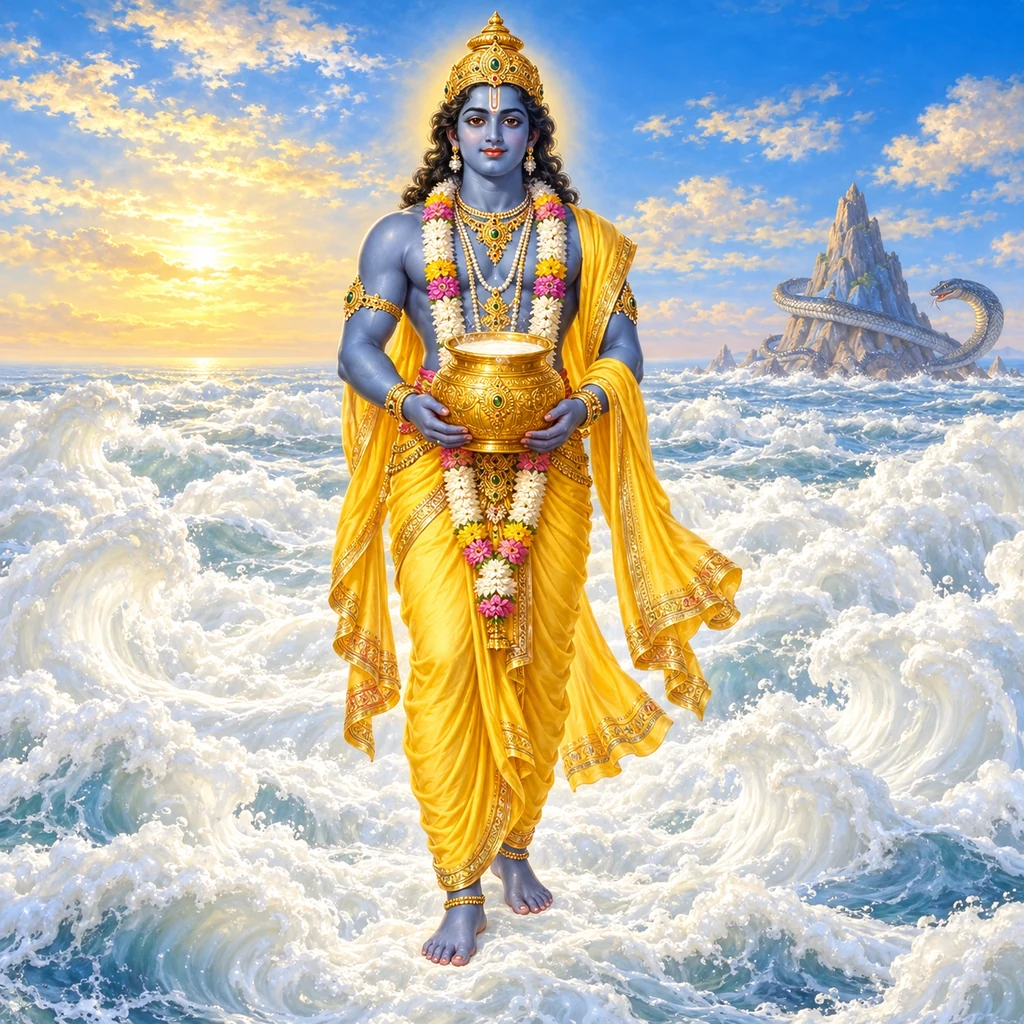
Dhanvantari appears with the nectar of immortality

Dhanvantari appears with the nectar of immortality
Dhanvantari’s appearance SB 8.8.33
Dhanvantari appears with the nectar of immortality

Pramāṇa (Śāstra reference)

Śrīmad-Bhāgavatam 8.8.31 describes a wonderful male person appearing from the Ocean of Milk as the demigods and asuras churn it. Verse 32 describes His youth, dark complexion, long strong arms, three neck lines, reddish eyes, garland and ornaments. Verse 33 describes yellow garments, a broad chest, earrings, well-kept curling hair, bangles and a vessel filled to the brim with nectar. Verse 34 identifies Him as Dhanvantari, explains His relationship with Lord Viṣṇu, and mentions His knowledge of medicine. The chosen moment is His appearance with the nectar, before the asuras seize it. The crown, pose, feet shown above the waves, lighting and arrangement of Mandara and Vāsuki are artistic choices. These four verses do not explicitly state the number of arms; the two-armed depiction is not presented as the only permissible iconographic form.

Saṅkṣepa (short meaning)

The Ocean of Milk is being churned. From its waters appears the beautiful youthful Dhanvantari, powerfully built, garlanded and dressed in brilliant yellow garments. He carries a vessel filled to the brim with nectar. Śukadeva Gosvāmī explains to Parīkṣit that this is a manifestation of Lord Viṣṇu, versed in the science of medicine. The illustration selects Dhanvantari’s appearance, before the later events involving the nectar.

Śāstra-pramāṇa (key points from the text)

The ocean is churned
The demigods and asuras seek nectar, and a wonderful male person appears from the churning ocean (8.8.31).
(Śrīmad-Bhāgavatam 8.8.31)
Youth and strength
The verse describes His youth, dark complexion, strong arms, garland and ornaments (8.8.32).
(Śrīmad-Bhāgavatam 8.8.32)
The vessel of nectar
Wearing yellow garments, earrings and bangles, He carries a vessel filled with nectar (8.8.33).
(Śrīmad-Bhāgavatam 8.8.33)
His identity is revealed
Śukadeva names Him Dhanvantari and explains His relationship with Lord Viṣṇu (8.8.34).
(Śrīmad-Bhāgavatam 8.8.34)
Knowledge of medicine
The same verse describes His knowledge of medicine and His share in sacrifices (8.8.34).
(Śrīmad-Bhāgavatam 8.8.34)

Tattva (essential teaching) — with śāstra

Hear the description carefully
The narration reveals the appearance, bodily features, vessel and identity in sequence. We should not replace the text with invented details.

Śrīmad-Bhāgavatam 8.8.31

Beauty joined with strength
The scripture describes youth and beauty together with a powerful body, not an infirm or frail appearance.

Śrīmad-Bhāgavatam 8.8.32

Nectar in this episode
The vessel of nectar belongs to the specific churning narrative. The picture does not promise bodily immortality to its viewer.

Śrīmad-Bhāgavatam 8.8.33

Dhanvantari and Lord Viṣṇu
Verse 34 identifies Dhanvantari’s spiritual position. The account should not be reduced to the image of an ordinary physician.

Śrīmad-Bhāgavatam 8.8.34

Sevā today (practice for this day)

1. Hear the Holy Name attentively
During japa, return your attention to every spoken Name. Afterwards, read the four verses on Dhanvantari’s appearance slowly, without adding invented details.
2. Offer thoughtful care
Help someone who is struggling: bring something needed, listen, or help them find appropriate support. Care for health should not be replaced with promises of miraculous cures.
3. Give thanks for the opportunity to serve
Consider how to use your strength carefully in service. These exercises are editorial reflections on the lila, not medical advice or verbatim instructions from the verses.
Dhanvantari appears from the Ocean of Milk carrying a vessel filled with nectar.
— Brief paraphrase of Śrīmad-Bhāgavatam 8.8.31–34

How to use this darśanam page

View the image, read the narration and śāstra-pramāṇa, contemplate the tattva, and complete the practice through seva. Follow the sequence: darśana → śravaṇa → manana → seva.